Backcountry Camping
The Experience:
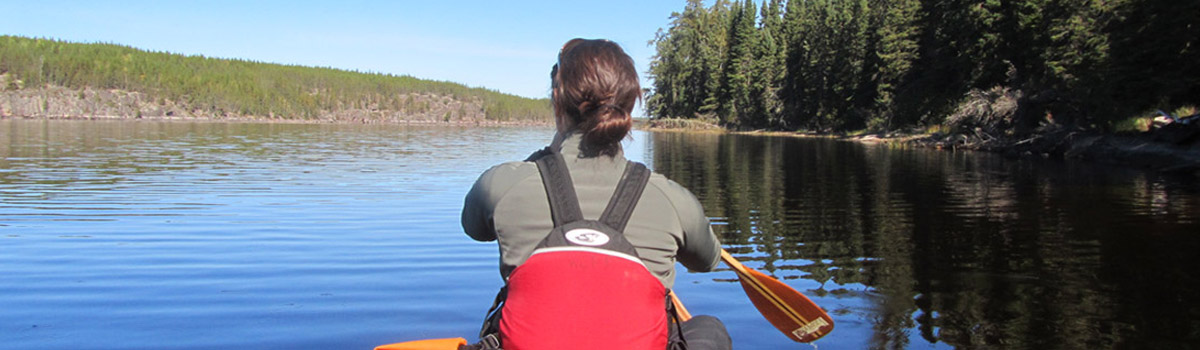
Woodland Caribou Provincial Park is renowned for its remote backcountry camping experience. The park offers several paddling routes, many with excellent fishing opportunities. The high occurrence of Canadian Shield rock outcrops and the open boreal setting are ideal for a variety of campsites, with up to 1,000 to choose from.
Registrations and Backcountry Permits
When you’re ready to visit, park permits may be obtained online at Ontario Parks Reservation System under the backcountry registration tab. Select your arrival date, party size, and entry point, then click search. You can then “Build Your Stay” by selecting an exit point and adding nights to your stay. Permits may only be purchased online up to two weeks in advance and are non-refundable. You may also obtain a permit at the Red Lake Ontario Parks Office at 227 Howey Street, Monday to Friday, 8:30 am to 4:30 pm. Permits can also be purchased at the self serve kiosk (cash only) outside the Ontario Parks Red Lake office.
Trip Planning
Park canoe route maps are available for purchase online, at the Red Lake Park Office or through local outfitters.
There is a ban on glass bottles in Woodland Caribou.
Road Information
Small washouts, loose gravel, and occasional flooding make travel to road access points difficult and is not recommended for vehicles without good ground clearance. Detailed information about road routes can be found under the ‘maps’ tab of this page.
Keep in mind that road conditions can change rapidly due to beaver activity and precipitation. Be aware and be prepared. While you do not require a 4×4 vehicle on this road, a vehicle with good clearance is recommended.
Some roads may have ongoing forestry operations and other activities on them. You may be sharing the roadway with equipment such as harvesting machinery and log haul trucks. Please drive with caution.
Each drive-to access point is marked by small wayfinding sign. Each access point has a small parking lot and a kiosk that includes a park map and a notice board. Please note that camping at the parking area is not permitted. We urge you to bearproof your vehicle if leaving it at the access point. Do not leave food, food wrappers, or garbage in your vehicle.
Campsites
Please be respectful of the natural environment and other visitors. Practice leave-no-trace camping, and be aware of your surrounding neighbours, ecology, and wildlife. We appreciate your efforts to maintain this pristine environment.
The best practice when choosing a campsite in Woodland Caribou is to select from the park’s designated campsite inventory map. In this way, visitors can limit their impact on sensitive values (environmental and cultural).
We are in the process of revisiting approved campsites to reassess the viability of the sites in burned areas of the park. Please use caution in areas of previous burns – trees may be overhead hazards. Avoid setting up tents in the vicinity of these hazards where possible.
The campsites in Woodland Caribou are primitive. Campsites are discreetly marked by a small fire ring and natural tent spaces. Campsites are not signed and may not be easily spotted from the water. Tent pads consist of open flat or slightly angled bare areas over moss or bedrock. The clearing of vegetation, brush, and small trees to create new campsites or accommodate more tent pads is not permitted. Campsite occupancy is limited to a maximum of 9 people, though many sites cannot accommodate this number.
The use of hammocks is welcomed on backcountry campsites. However, due to the high number of young regenerating forests post wildfire, setting up a hammock may not be possible at most campsites.
Portage Clearing
Woodland Caribou Provincial Park offers nearly 2,000 km of interconnecting canoe routes. Park staff work diligently to keep portage routes and campsites maintained, but visitors should anticipate that each route is not visited by staff annually. Maps of the past two years of maintenance efforts are available under the Maps tab.
Portages can become hard to find following forest fires, especially when re-growth happens in a recent burn. For this reason, crews sometimes use blazes, flagging tape, and rock cairns to assist visitors in locating and following the trails. Otherwise, the use of flagging tape is discouraged.
Please report any trail that may require attention (chainsaw work) to woodland.caribou.mnr@ontario.ca, as this will help us prioritize work efforts.
Winter Camping
Winter camping, ice fishing, snowshoeing and cross-country skiing are permitted, but access is limited during the winter months. There are no groomed winter trails in the park.
Ice fishing is subject to Ontario’s fishing regulations.
Snowmobiling is only permitted in the access zones of park additions. There are no groomed park trails. Contact the Park Office for specific details and maps.
Winter visitors should take extra precautions. Woodland Caribou’s isolated location means help is not nearby. Only those with significant winter wilderness experience should stay overnight in the park.